Why Bug Zapper Return Rates Spike: The Science of UV Light Decay & How to Fix It
六月 23, 2026
Are your Amazon bug zappers losing effectiveness? Learn the root cause of UV light decay, how substandard components impact your return rates, and the engineering standards required for long-term reliability.
The Hidden "Return Rate Killer": Why Bug Zappers Fail Long-Term Performance Tests
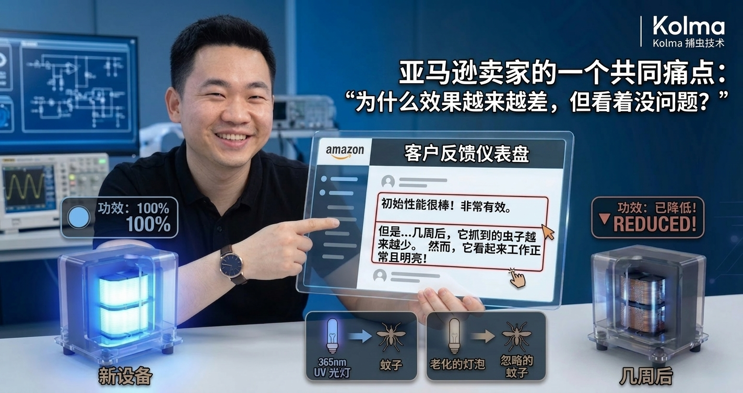
Many Amazon brand owners face a recurring nightmare: A product launches, gains positive feedback in the first 30 days, then suddenly triggers a spike in returns by the end of the season. The customer feedback is consistent: "It looks bright, but it stopped killing mosquitoes."
This is not a matter of chance; it is a measurable engineering failure known as UV Light Decay. For brands targeting the U.S. residential market, understanding this phenomenon is the key to maintaining a low return rate and building a sustainable reputation.
The Root Cause: Visible Light vs. Functional UV
Performance stability depends on the distinction between "Visible Light" and "Functional UV." To the human eye, a blue-purple glow suggests the device is operational. However, mosquitoes are uniquely sensitive to the 365nm wavelength. When the intensity of this specific wavelength drops, the device retains its visual brightness but loses its biological attraction power, rendering it ineffective.
Technical Drivers of UV Decay
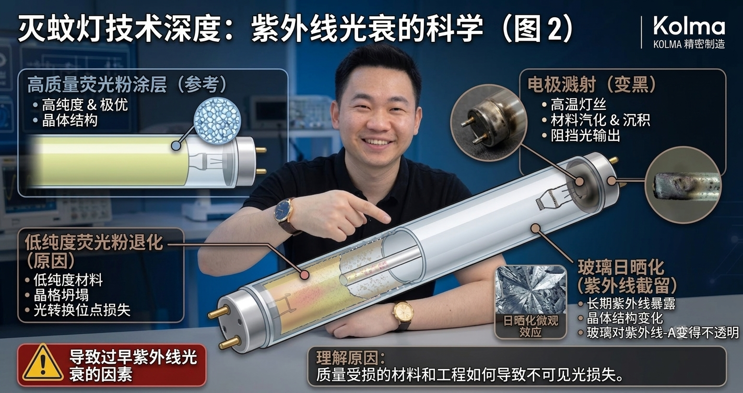
Based on industrial standards for UV-A lamp longevity, light decay is the result of four distinct engineering compromises:
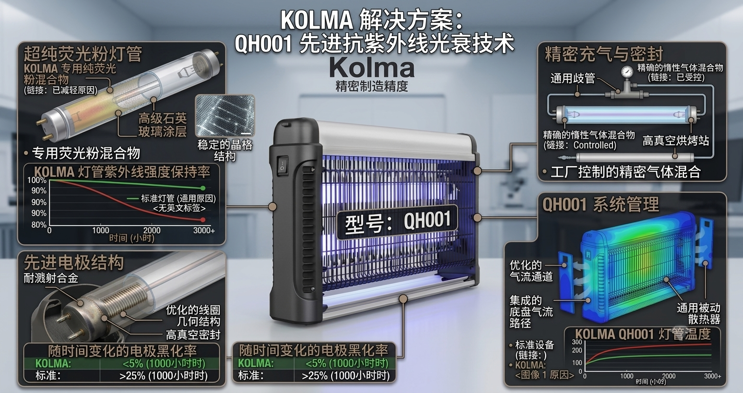
- Phosphor Degradation: If phosphor purity is low, the molecular structure collapses under continuous UV excitation, causing rapid efficiency loss.
- Electrode Sputtering: Insufficient vacuum sealing or low-grade filament materials lead to metal ions depositing onto the glass, forming a "black-out" film that blocks UV output.
- Glass Solarization: Substandard glass chemistry reacts to long-term radiation, causing the material to become opaque to the specific UV waves required for pest control.
- Thermal Instability: Inadequate airflow design causes excessive heat, which accelerates the chemical breakdown of internal components.
Engineering Standards for Stability
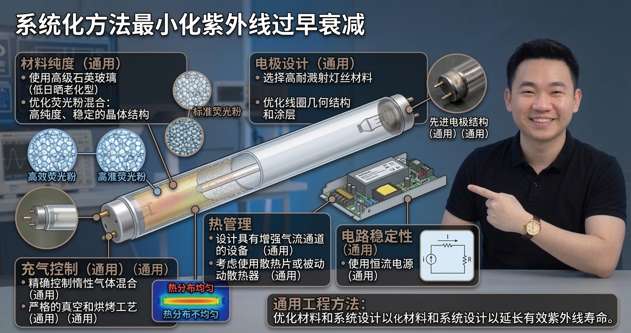
Achieving durability requires a shift in focus from "initial unit cost" to "component integrity." To ensure long-term performance, high-quality pest control devices must meet the following engineering benchmarks:
- High-Purity Phosphor Blends: Ensuring stable crystalline structures that maintain spectral intensity over 2,000+ hours.
- Precision Vacuum/Gas Control: Rigorous bake-out processes to eliminate impurities and prevent electrode sputtering.
- Thermal-Management Engineering: Designing chassis airflow to maintain the lamp core within its optimal temperature range, preventing premature degradation.
The Bottom Line for Brand Owners
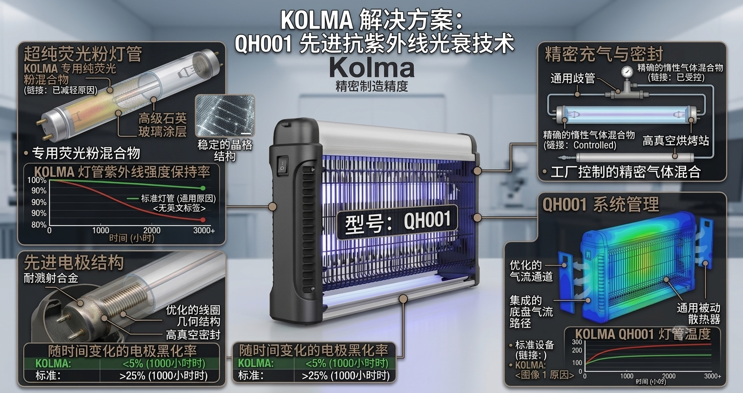
If a product's performance data relies solely on "initial brightness" rather than a 2,000-hour aging test report, its service life is inherently limited. These engineering benchmarks—as demonstrated in our QH001 series—should be the baseline for any reliable pest control device. To effectively mitigate long-term return rates, brand owners must demand transparent aging performance data from their supply chain.
1: Amazon customer feedback showing bug zapper performance issues
2: Technical diagram of UV light decay and phosphor degradation in bug zappers
3: Systematic methods to minimize premature UV decay in pest control devices
4: Kolma QH001 advanced anti-UV decay technology engineering specifications