2026 North American Commercial Insect Killer Procurement White Paper: 3 Hidden Technical Indicators Beyond Certifications
五月 9, 2026
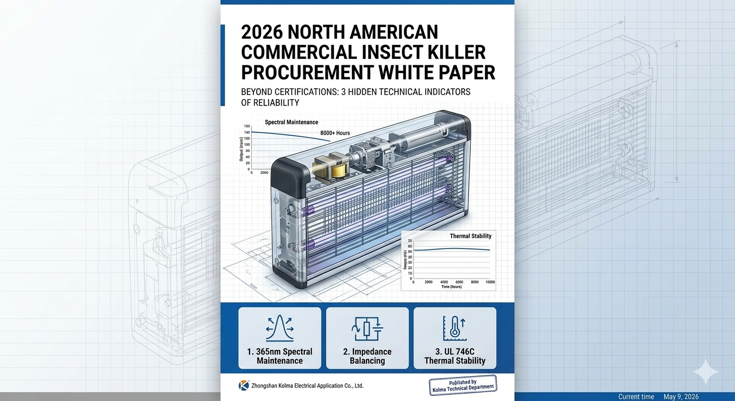
UL and EPA certifications are just entry tickets for the 2026 North American market. Major distributors are pivoting toward 'Full Life-Cycle Reliability.' This white paper deconstructs three critical, often overlooked technical indicators—UVA decay, impedance balancing, and thermal-oxidative stability—that determine long-term profitability and safety. Download the full report to upgrade your procurement standards.
Executive Summary
In the North American B2B market, UL, ETL, and EPA certifications are mere "entry tickets." As supply chain transparency and energy efficiency requirements heighten in 2026, major distributors (like Grainger, McMaster-Carr) are pivoting toward "Full Life-Cycle Reliability." This white paper deconstructs three critical technical indicators—often overlooked during procurement—that determine the long-term profitability and safety of industrial insect killers.
Indicator I: UVA Decay Rates and 365nm Spectral Maintenance
The Industry Context
While many buyers focus on wattage, entomological research confirms that the peak attraction wavelength for phototactic insects is precisely λ = 365nm. According to the Journal of Economic Entomology, a shift of just 10nm in spectral output can reduce attraction efficiency by over 60%.
"Spectral Maintenance is the true measure of a lamp's professional grade. A bulb that glows blue but fails to emit UVA is functionally obsolete."
Technical Breakdown
Cheaper lamps utilize standard halo-phosphors which suffer from rapid "solarization." Within 1,000 hours, UVA output can drop by 40%. Commercial-grade standards, such as those maintained by Kolma, demand a maintenance rate of > 80% at 8,000 hours. This is achieved through lead-hard glass envelopes with internal protective coatings to prevent UV-induced crystallization of the glass bulb.
Indicator II: Impedance Balancing and Transformer Resilience
The 120V/60Hz Challenge
The North American electrical grid presents unique stresses. High-frequency electrical discharges in commercial environments often lead to transformer failure due to insulation breakdown within the coils during "arc-over" events.
Kolma Engineering Insight
For commercial scenarios, high-quality Magnetic Leakage Transformers outperform electronic ballasts in current-limiting during continuous discharges. Physics dictates that the capacitive effect of the high-voltage grid must match the transformer's output impedance. Poor matching results in excessive arcing, carbonizing the grid and causing permanent short circuits.
Rigorous Metric: The Kolma QH-Series transformers are tested to withstand 30,000 consecutive discharge cycles without thermal overload.
Indicator III: Thermal-Oxidative Stability and Delta YI (Yellowness Index)
Material Science in Harsh Environments
Insect killers operate in extreme physical environments: high-intensity UVA exposure combined with localized heat from ballasts. Standard ABS plastics undergo rapid photo-oxidative degradation, becoming brittle—a phenomenon known as "UV embrittlement."
Expert View: To avoid costly recalls, procurement contracts should specify materials compliant with UL 746C for UV exposure resistance.
Conclusion: The 2026 Procurement Baseline
Certifications ensure legality; technical indicators ensure profitability. For North American distributors, a single large-scale recall can destroy brand equity. We recommend three mandatory technical clauses for future contracts:
- Submission of 8,000-hour spectral maintenance test reports.
- Transformers must feature short-circuit protection mechanisms tested at 105°C.
- Housing materials must provide data compliant with UL 746C UV exposure standards.